Konnichiwa from Osaka — I’m CHIO.
I’m an esthetician in Japan, where I work hands-on with women’s skin every day.
When I read about Japanese skincare overseas, I often see it described as a seven-step, nine-step, or even more elaborate routine. And yes, Japanese skincare can sometimes involve many steps.
But from inside Japan, I think there is something more important than the number of products we use: we look at our skin, notice small changes, and adjust what we do. Some days we add more hydration. Some days we use a mask. And some days, when the skin feels sensitive, doing less may be the better choice.
Japanese Skincare Routine: The Short Answer
THE BASIC RHYTHM
Cleanse → Hydrate → Moisturize → Protect
Start with the basics. Then adjust according to the skin you see today.
In the morning, sun protection is added. At night, makeup and sunscreen are removed before cleansing. Serums, masks, essences, and other treatments can be added when your skin needs them.
The routine is a foundation — not a fixed rulebook.
KEY MESSAGE
J-Beauty is not about how many products you use.
It is about paying attention to your skin and caring for it consistently over time.
Morning & Night: The Basic Japanese Skincare Routine
MORNING
Protect the day ahead
01 Gentle cleansing
02 Japanese lotion — keshosui
03 Serum, if needed
04 Emulsion or moisturizer
05 Sunscreen
NIGHT
Reset and restore
01 Remove makeup & sunscreen
02 Cleanse gently
03 Hydrate with lotion
04 Add what your skin needs
05 Finish with moisture
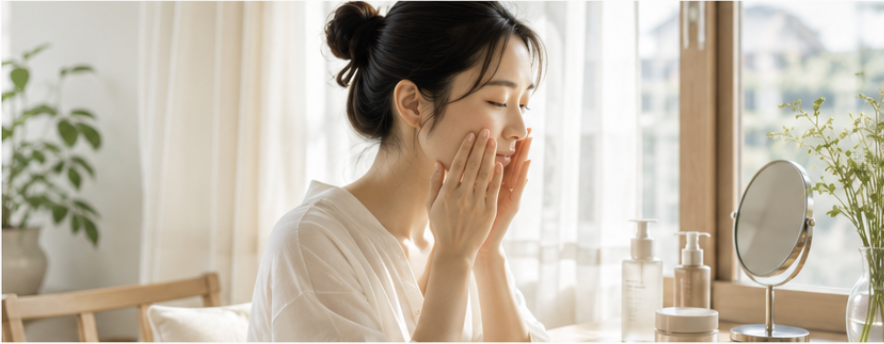
Morning Japanese Skincare Routine
01 — Cleanse gently
The goal is not to make the skin feel squeaky-clean. Cleansing should remove what needs to be removed without treating the skin roughly.
Depending on your skin and the products used the night before, morning cleansing may be kept very simple.
02 — Apply Japanese lotion: keshosui
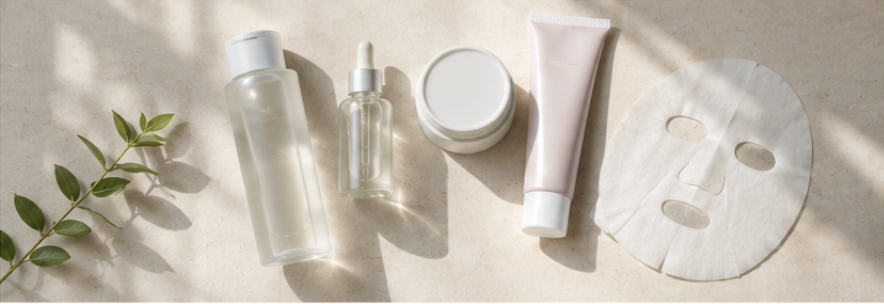
In Japan, what we call keshosui is often translated as “lotion,” but it is usually a lightweight hydrating liquid used after cleansing.
It may sound similar to a toner, but hydration is often the main idea.
03 — Add a serum if your skin needs it
A serum is not something you have to use simply because it appears on a skincare checklist.
You might add one for hydration or another targeted concern when your skin needs extra care.
04 — Use an emulsion or moisturizer
Emulsions — nyueki in Japanese — are very familiar in Japanese skincare. They are typically lighter than a rich cream and are used after lotion to help maintain moisture.
05 — Protect your skin from the sun
Sun protection is one of the most important parts of the morning routine when we think about the skin not only today, but years from now.
This is where Japanese skincare naturally connects with preventive skincare, Aging Well, and Skin Longevity.
Night Japanese Skincare Routine
01 — Remove makeup and sunscreen
Japanese skincare often treats makeup removal and facial cleansing as separate steps.
02 — Cleanse the skin
This is where the idea of double cleansing comes from: first removing makeup, sunscreen, and oil-based residue, then washing the skin.
But I do not think “double cleansing” should become another rule everyone follows without thinking. The products you use and the condition of your skin matter.
03 — Hydrate with lotion
After cleansing, Japanese lotion is commonly used to give the skin hydration before the next steps.
04 — Add what your skin needs tonight
This might be a serum. It might be a sheet mask. It might be an extra layer of hydration.
Or it might be nothing extra at all.
05 — Finish with moisture
An emulsion, moisturizer, or cream can help maintain hydration through the night.
WHY SO MANY STEPS?
More steps don’t necessarily mean more skincare.
Sometimes, they mean paying closer attention.
When you write down every possible part of Japanese skincare — makeup remover, face wash, lotion, essence, serum, sheet mask, emulsion, cream, sunscreen — the list can become quite long.
But I don’t think the number of steps is really the point.
For me, one reason Japanese skincare can appear so detailed is that there is a habit of paying attention to the skin and adjusting care depending on how it feels.
DRY TODAY?
Add a little more hydration.
FEELING SENSITIVE?
Keep the routine simpler.
SEASON CHANGED?
Adjust what your skin needs.
Inside Japan: The Routine Is a Starting Point, Not a Rulebook
01
LOOK
Look at your skin before automatically following the next step.
02
ADJUST
Add care when you need it — and simplify when you don’t.
03
CONTINUE
Think in years, not only in days.
A skincare routine is useful because it gives us a foundation. But skin is not exactly the same every morning and every night.
More skincare is not always better skincare. There are days when adding hydration or targeted care feels right, and days when keeping things simple feels better.
Clean gently. Hydrate. Moisturize. Protect from UV exposure. Repeat. These small actions may look ordinary, but doing them consistently is exactly why I find them interesting.
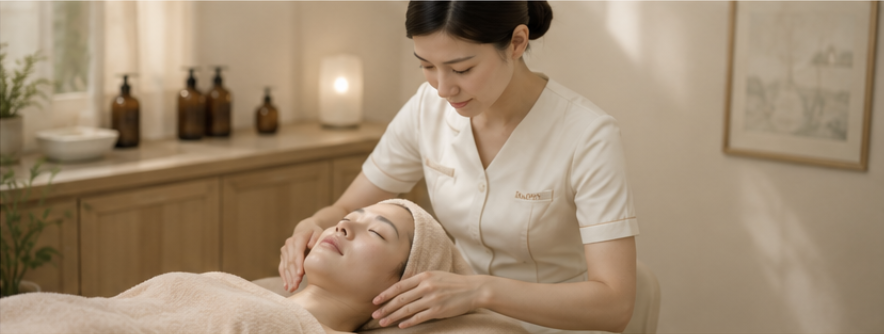
CHIO FIELD NOTE
From my treatment room in Osaka
Working as an esthetician, I touch and observe real skin every day.
One thing I have learned is that skin rarely stays exactly the same.
Sometimes I can see dryness. Sometimes the skin feels more sensitive than usual. Sometimes someone tells me, “I always use the same products,” even though her skin is clearly asking for something different that day.
That is why I don’t want skincare to become a checklist that you complete without looking at your face.
Your routine matters. But your ability to notice your skin matters too.
I think that quiet habit — looking, touching gently, noticing, and adjusting — is one of the most beautiful parts of Japanese skincare.
CHIO’S TAKEAWAY
A routine is a starting point.
Your skin decides what comes next.
Why Japanese “Lotion” Is Different
If you are new to Japanese skincare, “lotion” is one word you need to know.
A Japanese skincare lotion — keshosui — is generally a lightweight hydrating step used after cleansing and before emulsion or moisturizer.
This is different from the meaning of “body lotion” in English, and it is also not always the same as an astringent toner.
Hydration is an important theme in Japanese skincare, which is one reason lotion appears so frequently in Japanese routines.
EVIDENCE / WHY IT MATTERS
Shiseido’s Japanese skincare guidance describes the basic sequence of lotion after cleansing followed by emulsion, with lotion supplying hydration and emulsion helping maintain moisture.
The American Academy of Dermatology recommends daily sun protection as a foundation of caring for aging skin and recommends broad-spectrum SPF 30 or higher.
Sources: Shiseido Beauty Journey; American Academy of Dermatology.
How to Start a Japanese Skincare Routine
01 / START SIMPLE
Build a basic routine you can return to every day.
02 / CHECK YOUR SKIN
Notice whether it feels dry, sensitive, comfortable, or different.
03 / ADJUST
Add only what makes sense for your skin today.
Morning:
Cleanse → Lotion → Moisturizer → Sunscreen
Night:
Remove makeup/sunscreen → Cleanse → Lotion → Moisturize
Final Thought
I don’t want you to finish this article thinking you need a Japanese seven-step routine.
I want you to take something simpler from it.
Look at your skin.
Have a basic routine you can return to, but allow it to change when your skin changes.
Add when you need more. Do less when your skin needs less. And keep caring for it tomorrow, next month, and years from now.
J-Beauty isn’t about looking younger overnight.
It’s about caring for your skin so it ages beautifully.
A little question for you
Do you follow the same skincare routine every day, or do you change it depending on how your skin feels?
ARIGATO for reading.
CHIO
Japanese Esthetician in Osaka
Skin, the Japanese Way

Comments