Japanese Skincare Philosophy: Nurture Your Skin, Don’t Fix It
When people discover J-Beauty, they often begin with products.
Japanese cleansing oils.
Lotions.
Essences.
Sunscreens.
Sheet masks.
But after working as an esthetician in Osaka and touching women’s skin every day, I believe the most important part of Japanese skincare is not a product at all.
It is the way we think about skin.
Skin is not something you manufacture. It is something you nurture.
And behind that idea is another principle that I believe is deeply connected to Japanese beauty:
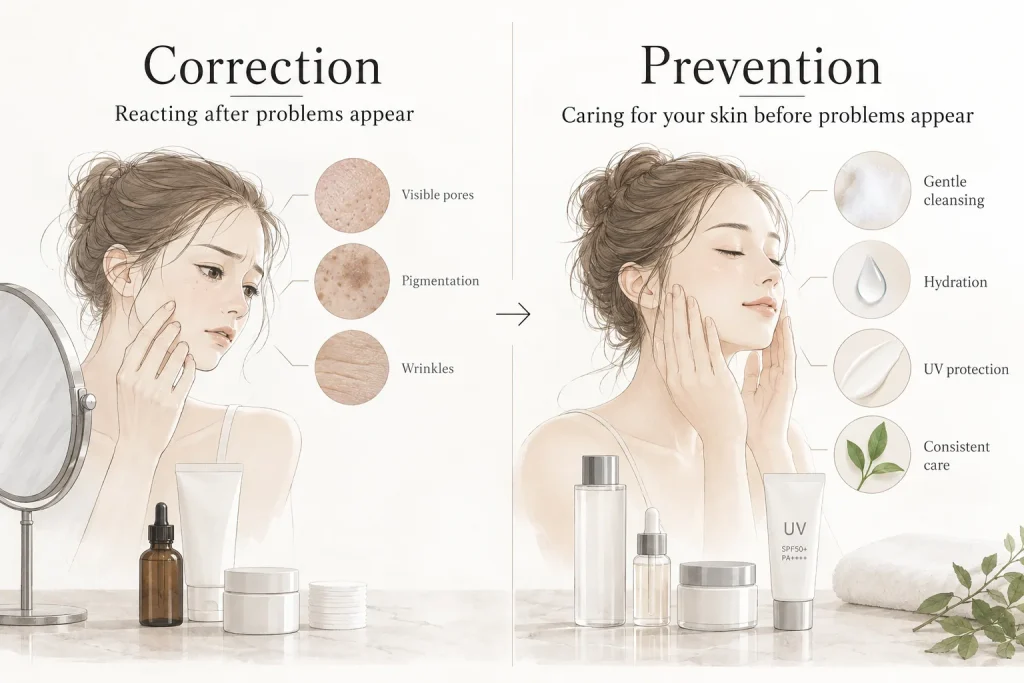
Japanese beauty has long valued prevention over correction.
Rather than waiting until dryness, pigmentation, roughness or visible signs of aging become significant concerns, many Japanese beauty habits focus on caring for the skin consistently before those concerns become more difficult to manage.
Hydrate before the skin becomes severely dry.
Protect it from UV exposure every day.
Cleanse gently instead of repeatedly stressing the skin.
Continue simple care even when there is no dramatic problem to fix.
This does not mean that every Japanese woman follows the same routine, or that Japanese skincare is always gentle and perfect. Japan has trends, intensive treatments and endless beauty products just like anywhere else.
What I am talking about is a philosophy I repeatedly see underneath many Japanese skincare habits:
Do not wait until the skin needs to be repaired.
Create an environment in which it can function well.
Protect it from unnecessary damage.
And continue caring for it every day.
That is what I mean by Japanese preventive beauty.
If you are new to J-Beauty, you may also want to read What Is J-Beauty? A Japanese Esthetician’s Guide to Japanese Skincare.
Japanese Skincare Has Long Valued Prevention Over Correction
Modern skincare is often introduced through concerns.
Visible pores.
Dryness.
Pigmentation.
Rough texture.
Wrinkles.
There is nothing wrong with addressing a specific concern. Effective active ingredients and medical treatments absolutely have their place.
But Japanese skincare has traditionally placed strong value on another idea:
Taking care of the skin before a concern becomes more noticeable.
In my own work, I often think about one simple question:
What does this skin need now to stay in a better condition over time?
Sometimes that means removing buildup.
Sometimes it means adding hydration.
Sometimes it means reducing unnecessary steps.
Sometimes it simply means protecting the skin and continuing the basics.
This is the idea behind what I call nurturing the skin.
Not waiting for visible damage before taking action.
Supporting the skin every day.
What Does It Mean to “Nurture” Your Skin?
Nurturing skin sounds abstract, but in everyday skincare it becomes very practical.
Cleanse Without Unnecessary Friction
Cleansing is necessary.
Excessive friction is not.
One thing I want more people outside Japan to understand is that cleansing should not feel like scrubbing a dirty surface.
Your face is living tissue.
You do need to remove makeup, sunscreen, excess sebum and daily residue. But stronger pressure does not automatically mean cleaner skin.
This is why low-friction skincare is one of the principles I care about most.
Use enough product.
Let the cleanser move across the skin.
Do not repeatedly rub the same area.
When you rinse, be gentle.
When you dry your face, press the towel against the skin rather than dragging it across your face.
These actions may appear insignificant when you do them once.
But skincare is repeated hundreds and thousands of times.
That is why the way you touch your skin matters.
Preventive beauty is often built from actions this small.
Hydrate Before You Try to Correct
Japanese skincare puts enormous importance on hydration.
This is also why Japanese “lotion” is so different from what many English speakers imagine when they hear the word lotion.
Japanese lotion is usually a lightweight hydrating step used directly after cleansing.
You can read more about this in What Is Japanese Lotion? Why Hydration Comes First in J-Beauty.
For me, hydration comes before trying to make the skin look perfect.
When skin feels dry, tight or uncomfortable, my first instinct is rarely:
“What stronger treatment can we add?”
I first want to know:
Is the cleansing appropriate?
Is the skin receiving enough water?
Are we doing too much?
Is the person touching or rubbing their face excessively?
What happens during the other 23 hours of the day when they are not in my treatment room?
This is where Japanese skincare becomes less about a single product and more about daily behavior.
And this is also where prevention begins.
You do not have to wait until the skin becomes severely dry or visibly compromised before you start caring for its hydration.
Protect What You Already Have
Another important part of nurturing skin is protection.
You can spend a great deal of money trying to improve the appearance of your skin, but daily exposure continues whether or not you are actively “doing skincare.”
Ultraviolet radiation is one of the major external factors involved in premature skin aging. UVA can penetrate more deeply into the skin and contribute to loss of elasticity and premature aging.
This is why sun protection is not a special anti-aging treatment to me.
It is basic maintenance.
You do not have to wait until pigmentation or wrinkles become visible before thinking about UV exposure.
Protecting the skin today is part of caring for the skin you will have years from now.
To me, this is one of the clearest examples of Japanese preventive beauty.
Repeat the Basics Every Day
This may be the least exciting part of J-Beauty.
It is also one of the most important.
Consistency.
A sophisticated treatment once a month cannot completely compensate for what happens to your skin every morning and every night.
In my salon, professional treatments can help.
But I always think of home care as the foundation.
Your cleanser.
How you wash.
How you hydrate.
How you protect your skin from the sun.
How often you unnecessarily touch your face.
These ordinary actions do not make dramatic social-media content.
They are simply repeated.
And that is precisely why they become powerful.
Preventive beauty is rarely dramatic. It is usually quiet, consistent and repetitive.
What I See in My Treatment Room in Osaka
I want to separate something clearly here.
The following is my professional observation as an esthetician, not a universal scientific rule.
I work directly with women’s skin in Osaka.
And one of the things I repeatedly notice is that people often focus intensely on what they want to remove.
Sebum.
Blackheads.
Dead skin.
Visible pores.
Spots.
Texture.
They ask me:
“How can I get rid of this?”
But when I actually look at the skin, I often find myself thinking about something else entirely.
How is this person cleansing?
Is she rubbing?
Is the skin dehydrated?
How does it feel immediately after washing?
What does she do every day at home?
Because sometimes the thing that needs to change is not the number of products.
It is the way the skin is being treated every day.
I work with pores every day, and this is especially important with pore care.
A pore is not dirt.
A pore is part of the structure and function of the skin.
Trying to aggressively erase every visible pore can easily become an endless cycle of extracting, stripping, exfoliating and inspecting the skin from five centimeters away.
My approach is different.
Clean what needs to be cleaned.
Support hydration.
Reduce unnecessary irritation and friction.
Protect the skin.
Then observe how it changes over time.
That is what 育てる — sodateru, or “to nurture and grow,” means to me in skincare.
And it is also why I believe prevention is one of the most valuable ideas within Japanese beauty.
What Science Supports—and What Is My Personal View?
I think this distinction is important.
“Japanese skincare philosophy” and “Japanese preventive beauty” are cultural and professional frameworks.
They should not be disguised as medical science.
But several of the practical habits that fit this philosophy are also consistent with established dermatological guidance.
Gentle Cleansing Matters
Dermatologists recommend gentle cleansing and avoiding aggressive scrubbing because excessive friction and harsh cleansing can irritate the skin.
That is the scientific context.
My additional view, based on my work with clients, is that how people cleanse deserves far more attention than it usually receives.
The cleanser matters.
But so do the hands using it.
Hydration Supports the Skin Barrier
The outer layers of our skin form a barrier that helps regulate water loss and protects us from the outside environment.
Moisturizers can support hydration and aspects of barrier function, although different formulations work in different ways and not every moisturizer produces identical effects.
That is why I do not like reducing skincare to:
“Dry skin = apply something oily.”
Hydration and barrier care are more nuanced than that.
For me, the practical lesson is simple:
Skin needs an environment in which it can stay comfortable and function normally.
UV Protection Is Preventive Skin Care
There is strong evidence connecting ultraviolet exposure with premature skin aging.
Dermatologists therefore place sunscreen alongside moisturizer as a basic component of an anti-aging skincare routine.
To me, this is preventive beauty in its simplest form.
You cannot see tomorrow’s UV damage today.
You protect your skin anyway.
Not because there is already something to correct.
Because prevention begins before the problem becomes visible.
Why I Don’t Believe in Chasing Perfect Skin
I work in beauty.
Of course I want skin to look beautiful.
But I do not think “perfect skin” is a useful goal.
Real skin has pores.
Real skin changes.
It reacts to seasons, hormones, sleep, stress, age and lifestyle.
And aging itself is not a skincare failure.
One of the ideas behind Skin, the Japanese Way is what I describe as skin longevity.
I do not mean preventing the skin from aging.
That is impossible.
I mean caring for skin in a way that allows it to remain comfortable, resilient and beautiful-looking as the years pass.
This is where preventive beauty and skin longevity meet.
We are not trying to stop time.
We are trying to take care of the skin we have today so that it can age as well as possible.
That is a very different goal from trying to make a 45-year-old face look 20.
And personally, I think it is a much more meaningful one.
How to Apply the Japanese Skincare Philosophy
You do not need to live in Japan.
And you do not need to replace your entire skincare collection with Japanese products.
Start with your behavior.
When cleansing, reduce friction.
After cleansing, do not automatically assume that tightness means your face is “really clean.”
Give hydration a clear role in your routine.
Use a moisturizer appropriate for your own skin rather than simply adding more and more products.
Protect your skin from UV exposure consistently.
Introduce active ingredients because your skin needs them—not because the internet has decided everyone needs the same ingredient this month.
And perhaps most importantly:
Do not wait for a major skin concern before you start caring for your skin carefully.
That is the essence of prevention.
Give your routine enough time to observe your skin.
Skincare does not always need another product.
Sometimes it needs consistency.
For a practical look at how these ideas appear in everyday care, read Japanese Skincare Routine: What We Actually Do in Japan.
The Goal Is Not to Stop Aging. It Is to Age Well.
There is a sentence that represents how I want to talk about J-Beauty:
Japanese beauty has long valued prevention over correction.
That does not mean ignoring science or rejecting modern cosmetic treatments.
It means understanding that beauty care does not have to begin only after something becomes a problem.
Hydrate now.
Protect now.
Cleanse gently now.
Continue caring for your skin now.
Not because you are trying to keep your face frozen at one age.
But because the way you care for your skin today becomes part of how it looks and feels years from now.
That is why I also describe J-Beauty this way:
J-Beauty isn’t about looking younger overnight. It’s about caring for your skin so it ages beautifully.
Instead of asking only:
“How quickly can I change my skin?”
We can also ask:
“How do I want to care for this skin for the next ten years?”
That is a question worth asking at 30.
At 40.
At 50.
And beyond.
Because beautiful skin is not created in one dramatic moment.
It is shaped by what we repeatedly do.
Final Thoughts: Your Skin Is Something You Grow
The Japanese word 育てる — sodateru means to raise, nurture or grow something over time.
It is usually used for things that develop gradually.
Children.
Plants.
Skills.
Relationships.
And it is the word that best describes how I think about skin.
You cannot command a plant to grow tomorrow.
You create the right environment.
Give it what it needs.
Protect it.
Watch it.
Adjust your care when necessary.
And continue.
Skin is different, of course.
But the mindset is similar.
Japanese beauty has long valued prevention over correction.
For me, that means caring for the skin before there is something significant to correct.
Not through one perfect product.
Not through one dramatic treatment.
But through small choices repeated every day.
Your skin is something you live with for your entire life.
Treat it accordingly.
Sources
- World Health Organization: The known health effects of ultraviolet radiation
- American Academy of Dermatology: Skin care basics
- American Academy of Dermatology: How to select anti-aging skin care products


Comments